
Annual quandary...


And no…it isn’t to do with pumpkins, though they did pose another quandary of sorts! Why oh why have they all decided to expire this year, and at the same time? I know JAPs are renowned for not being good keepers…but they are good growers here, and as a general rule I get more months of storage from them before they begin to soften at the base of their stalks - having been left to cure post-picking, in the sun. Some, I brought inside to store; others, as I have done for years upon years gone by, I’ve left under cover, if outside; but it seems not to have made a jot of difference where they’ve been resting to keep this year…keeping they are not! And so, on Tuesday I took to all but three with a large cleaver (thank you Jeremy once again for posting me that excellent tool - was it last year or the one before?) making very easy work of halving each of those beauties to save all but the top of their central core, and doing something I’ve never done before…cooking that exquisite golden orange flesh to freeze.
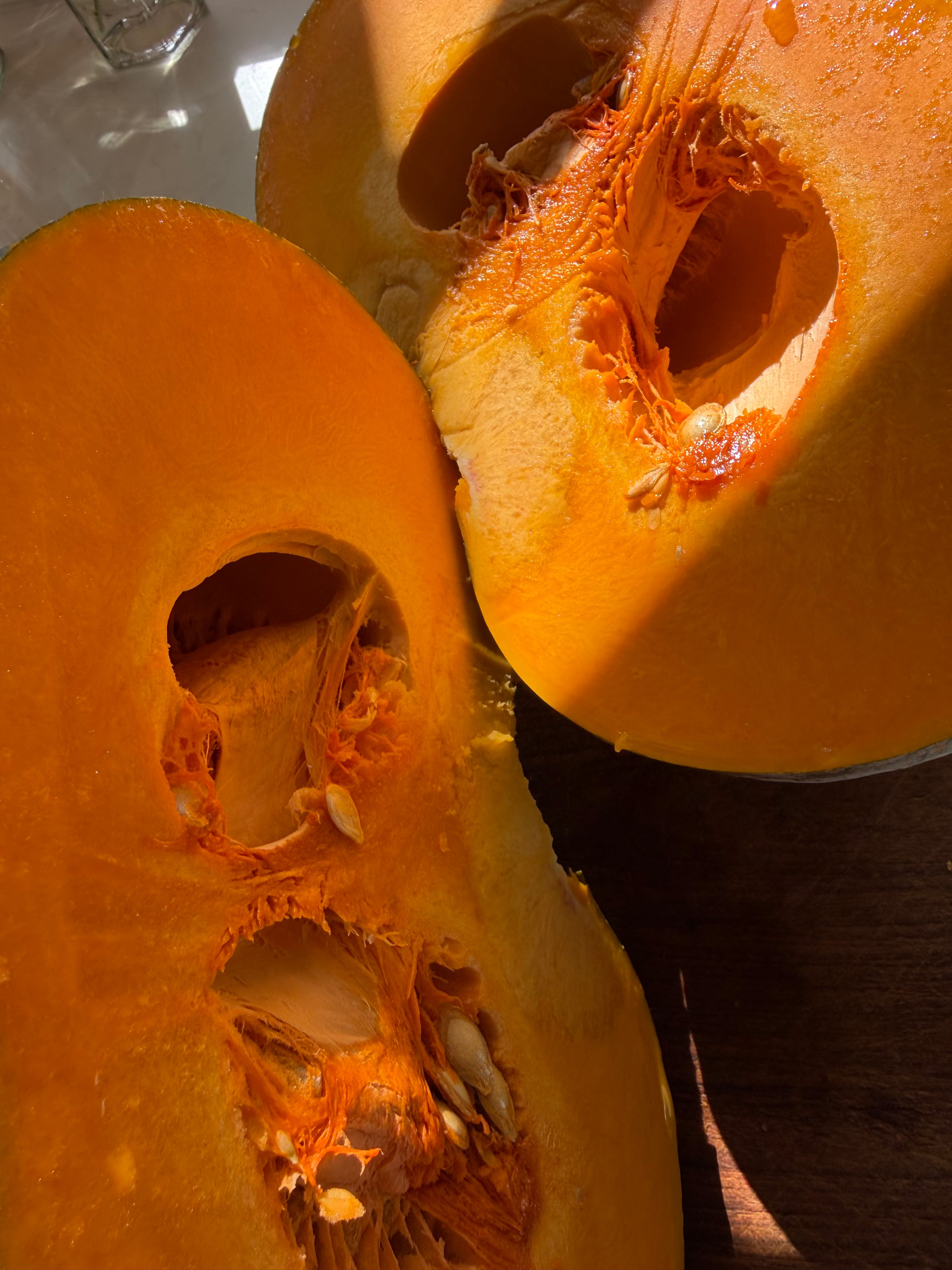
I made a batch of our favourite Pumpkin, Apple & Ginger Soup while I was about the primary task - which was to cut the flesh into cubes and pop them into the oven to batch-bake, two oven trays at a time. The yield was about five kilos of cooked pumpkin, which will undoubtedly head for further batches of said soup, as post freezing it will likely be too mushy to use for anything else. But that’s OK…there will be many chilly days ahead yet, for soup to be on the menu, and quite honestly? It’s the cutting of the pumpkin that takes the longest time in the process of making it - so although I’m not a huge fan of freezing, there are times when growing your own, that the process simply does make sense.
But no…the pumpkins are not the quandary to which I’ve made reference in the name of today’s post! And the quandary of the day doesn’t even come with an image..perhaps I should go out and take one? Leave it with me…let’s see where the tip-tapping takes us first, now I’ve settled in at my desk and the early morning sun has gone round just enough that its rays are no longer causing me to frown and squint (yes, I could draw the curtain across but I equally love basking in that beautiful light!). The quandary…relates to the annual decision making process for the care and nurture of the ornamental garden beds…
Now the bulk of the winter pruning is done, earlier in the week I made a list of the inputs we’re likely to need to complete the seasonal sequence of ornamental nurture and care. The biggest items on the list are always compost and mulch. For the kitchen garden and other edible specimens dotted around the main garden, we use our own home made compost - I wouldn’t have it any other way - our compost is something over which we labour with love. But the ornamental component of the garden requires more compost than we can make and so it’s an annual input for which we make an allowance; as we do too for its companion, mulch. And herein lies the quandary. I’ll explain….(this is going to be a tangent, so if you’re not a passionate gardener, you might want to turn away now for the next paragraph or so - not sure where I’m going beyond that!).
Back at the time when we made the ornamental garden beds (which came about fairly organically as we restored various buildings, and the need to link those structures by some means not just of order, but of beauty too became apparent); with our gardening training wheels on, so to speak, we learned early of the importance of adding compost to the soil - by way of enriching it as well as promoting better water absorption and holding capability, as well as encouraging the microbiome of the soil below to flourish. As you all know by now, the garden beds were made here using the no-dig method, encouraged by that book given to me by my grandmother at the very beginning of our garden-making journey - Esther Deans’ No-Dig Garden, written back in the 1970’s. Anyway…I’ve gone on abut that so many times before, so let’s move on! The thing is…back then, when thinking of a productive garden, it was not uncommon to see some covering, perhaps straw of some kind by way of mulch; but not so the ornamental garden. Or perhaps it was just that we were so drawn to taking our early lessons from English and European gardens, with their very visible loamy soil, that we ignored the next important step - to add mulch to our ornamental beds. In those early days too…and it’s funny how some little comments in conversation just stick with you, when you’re young and not quite sure and finding your way…but I do recall someone with a great deal of ‘garden experience’ commenting (in a rather derogatory manner) upon gardens where mulch seemed to be their main feature. These are the kind of comments that can cause confusion - especially to the young and inexperienced, as they find their way; afterall, a newly installed garden is likely to present as mostly mulch, before the poor plants have time to grow; just as in gardens that contain a lot of herbaceous material that is cut back during winter, when viewed in early spring seem to show off their mulch rather than the plants that will quickly spill over to cover it all up - in the latter instance, a space of mere weeks can be the difference between seeing predominantly mulch and then none at all - as it will soon be smothered!).
But one year, as we experienced a drought likely to continue for the foreseeable future, I elected to add a layer of sugar cane mulch to all our ornamental planting, where up ‘til that point, for years we’d just topped up the local mushroom compost mix from Jensen’s at the end of our little road (how very, very lucky we were to have them there for all those years - so easy to take the ute, have Col or Jerry drop a bucket or two from their tractor into its tray and drive it back to whichever satisfactory position would make it closest to the garden bed we (well…it has to be said..I was working on at the time!) to shovel…sometimes directly from ute to garden bed…others where we couldn’t get the ute in close enough, to fill barrow by barrow and wheel it in to shovel out around each and every plant…
Oh it is a job I so love to do! A ute tray filled with a mountain of rich-ponging compost is a beautiful thing…and there is such method to the process…difficult as it is at first, to take the height out of the mound on the back of the ute with a shovel without spilling it everywhere, once that first bulk is out of the way, the sequence involves scraping back the depth of the mound from front and sides, bit by bit, til gradually the ute tray is empty…(a bit like demolishing a cake over a period of days!) the repetitive sound of metal shovel on metal tray as each scoop is brought to the fore a rhythm…and with a twist of the body to release each shovel-load with good aim from back of garden bed to front, gradually each section is filled with the stuff - like dropping the feathery contents of an eiderdown on top of compacted, hungry soil…and once that weighty chocolate-brown material is in position (with perhaps a gentle brush of the hand to spread a solid drop) it is definitely not to be trodden on under any circumstance - hence the sequence of application goes from back of each garden bed…to the front!
At least that’s how it used to be…in the early days, when Jensen’s Nursery was still active, at the end of the road. Whereas these days, we have a truckload of compost delivered - dumped down in the carpark, and from there, (although the actual application to the beds is via the same method) it’s a case of filling the lawn mower trailer rather than the ute tray. Somehow, no matter from where it comes, this new stuff does not seem to have the same pungency, as the old from Jensen’s. The organic mulch one gets these days has so much ‘green waste’, it just doesn’t seem to have the punch of old, and I do get so annoyed when I find little bits of plastic in it, which seems inevitable these days.
Anyway…one year I decided to add mulch on top of that beautiful compost that was so visually arresting to me - with all the herbaceous plants cut down to soil level and the roses pruned to their skeleton (just as they are now….any debris from last season blown away by the chilly winds and a light frost having dusted the plants clean) - one could sense the sheer thankfulness of each and every plant…almost feel a gentle stirring within their cells as soon as the job was done. Now with the double layer…of compost and mulch, setting up the plants for whatever the season may throw at them, the end result felt even more successful - now one was assured their roots were protected from the elements: everyone was now beautifully tucked in, nurtured, and in response, would flourish.
For many years I went through a cycle of applying different mulches. During the first I rigorously applied sugar cane mulch…which contributed its ‘straw-like’ aesthetic throughout the ornamental garden. Aesthetically, while I personally rather like that contribution, it has to be said that perhaps it’s more appropriate in a productive garden, but that isn’t the reason I stopped using it - I stopped because we were in drought and with a bad fire season predicted, I didn’t much like the idea of trying to wet down all that brittle material, should the need arise. And so for the first time, one year instead we applied a mulch called ‘Forest Fines’. I personally don’t like chunky bark mulches - they just don’t seem right with the style of planting here, and anyway I’m always concerned at bark mulches leeching nitrogen from the soil, whereas more straw-like materials - especially lucerne, contribute nitrogen. Personally, I would always use lucerne if I hadn’t had such a bad experience early on, when one of our dearest friends kindly gave me some bales of his prize-winning lucerne to add to my earliest garden beds, and it set seed all the way through! Lucerne puts down very deep roots very quickly…and trying to weed it out was…well…!!!! Maybe that experience though was just a one-off, as in subsequent years I’ve layered it out thickly around the citrus trees in the chook run, in hope of encouraging lucerne to take root, but never had any luck at all!
Anyway, back to the quandary! And so we applied ‘Forest Fines’ for the first time, over the top of the ‘organic compost’ in the ornamental beds. The thing is, whereas in all those early years gone by, we’d added a blanket of compost twice a year - mid-winter and mid-summer (not as thoroughly mid-summer, but still some, after that severe mid-season prune that encourages a glorious autumn display, and because it had no mulch covering it back in those days, it would have pretty much decomposed by then); now, the Forest Fines mulch was not breaking down at the pace of those mulches of straw-like consistency. The life span of fine wood chip is much longer, which in some ways is good - afterall it’s doing its job well - almost too well. On the other hand it negates the need to ‘top up the compost’ with that lovely luscious blanket of goodness, not twice a year…and at this rate, perhaps not even once. Because the top layer of mulch takes so long to break down, it’s actually preventing the annual top up of what I consider to be the good stuff…the very stuff that feeds and nourishes the soil, which makes me feel quite perplexed.
Last year, we gave all the beds a thoroughly good dose of compost at this time of the cycle; and followed up with a lovely fresh topping of Forest Fines - all was right with the ornamental bedding. But this year, the mulch has not broken down to an extent that I feel comfortable smothering it with a blanket of compost and topping up again with a layer of mulch. And so in this way…the task that had once been a twice yearly proposition, has been reduced not even to an annual one, but become a bi-annual activity. And I don’t feel very happy with it.
The situation has in fact, not for the first time, had me crawling around on my hands and knees, literally breaking up the mulch that I feel is now compacted. I did one section, using gloved hands to disturb the surface in a bid to fluff it up (I will never forget the look on Alex’s face when I first mentioned fluffing up the compost! Alex came here to complete his horticultural apprenticeship…not entirely sure he knew what he was getting himself into when he asked if we might take him on!) which does indeed make a difference - visually and…somehow feels as though it frees the plants up, to breathe. And to accept whatever application may land in its opened up state.
And so the quandary? To add compost and mulch this year? Or not?
I can see even from here at my desk, that there are sections in the Arc where the mulch is very thin on the ground and so, much as I hate the idea, I can see some ‘half and half’ sections will likely be on the cards to receive both. But if not to add compost across the board, then feeding and nurturing the ornamental planting will require another tack. Of course this is not the first time this situation has occurred - it began with the first application of Forest Fines, which must be goodness…a decade ago? And so…if we are not to apply compost this year, well…I guess I will be on my hands and knees ‘mooshing’…breaking up the surface with my fingers, before a thorough application of pelletised chook manure and maybe blood and bone…not at the same time - maybe a week apart; and watering each in well, both before and after application. And then as the season progresses, maybe spraying with the odd dose of ‘seasol’ as a foliar feed. I do always add the first two anyway…before the compost, but never bother with any other kind of ornamental feeding during the course of the season…I’ve always believed in nourishing the soil, rather than feeding the plant.
So perhaps that’s the way it will be this year…it doesn’t sit well with me, but there it is…the soil is likely going to have to wait for its next luscious blanket of compost to be plopped gently on top of its surface; once last year’s layer of mulch has completely broken down underneath the vigorous (hopefully) growth of this year’s ornamental garden.
(By the by…some years I have reverted to sugar cane mulch in the ornamental beds, just to shake things up and also…in relation to wetting down the beds in a fire season…I do feel it’s easier to wet the Forest Fines more quickly - should the need arise…I can’t quite explain why, it just is.).
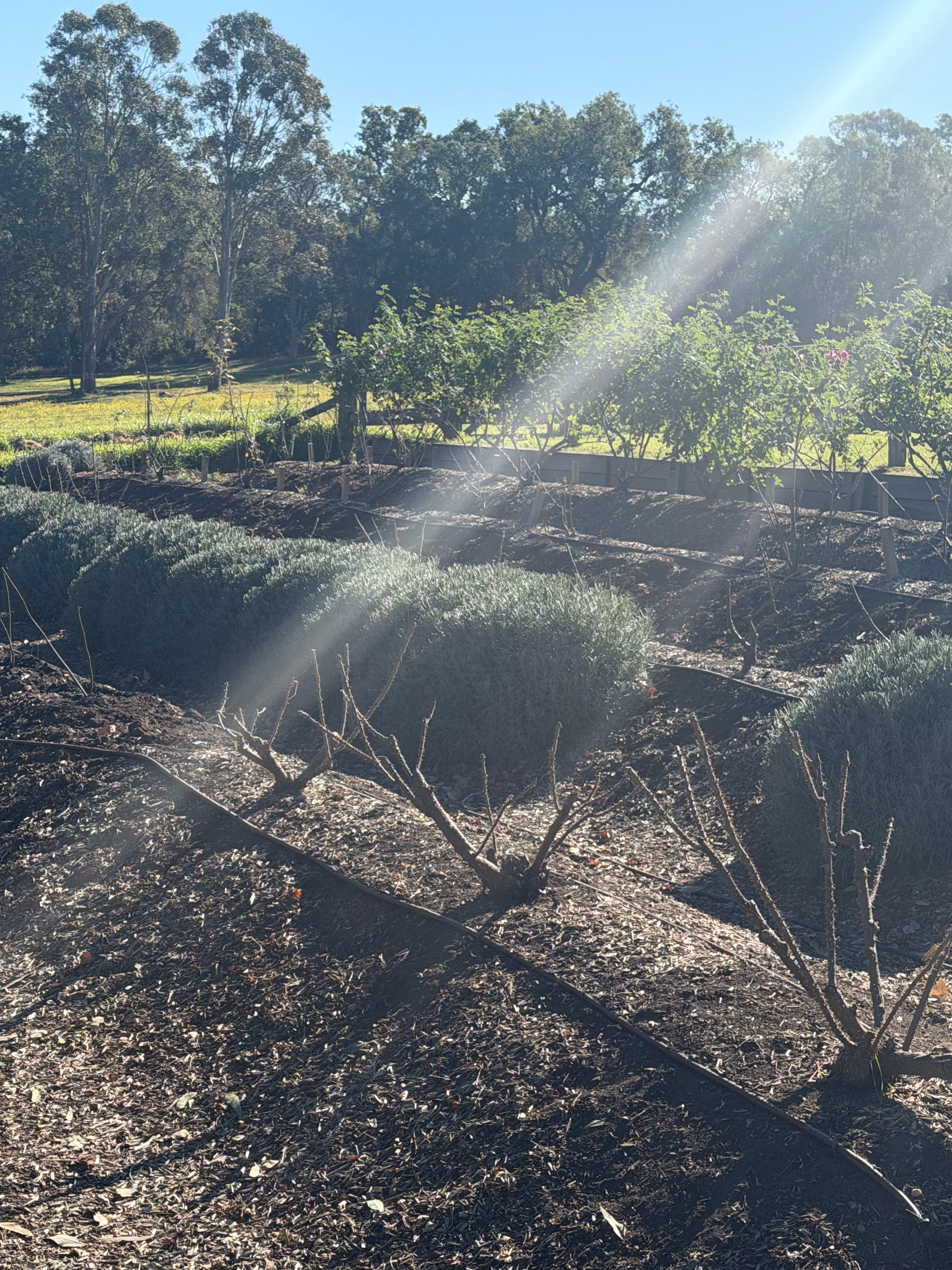
The one area though on which I won’t hold back is the Field. The rest of the garden is so well established, it can handle the approach I’ve described above. But I consider the Field to be a productive part of the garden and it’s about to get its annual bout of tender loving care; its layer of mulch has worn thin and requires a good topping up. I wonder…literally as I tip-tap away here, if this year, for the first time since we planted the Field, I add lucerne to the rows? Hmmm….? During the first years of the Field’s existence I applied sugar cane mulch to the raised rows, with Forest Fines to the paths where they do an excellent job. Then two years ago, given the sugar cane mulch moves around so much, I decided to apply the Forest Fines to the rows themselves, which provided a more stable top layer. But I wonder…? Either way, each row will get a hefty dose of compost! First though, each rose will get a generous handful of complete rose food (I use ‘Sudden Impact for Roses’) and having completed all the rose pruning last Saturday, although I do think it’s early in the season, I think I might do that this weekend; and make a start on barrowing compost up (after straightening out those ugly irrigation hoses and pinning them back into position!). I do hate the drip lines and funny thing is, I’ve hardly used them…but then when I have, I’ve been very grateful indeed that we did install them!
During the rose pruning I had to made a decision about a handful that, through no fault of their own, have not survived this last year. I know not what creature it is, that likes to come in and swipe at individual stems, snapping them off in a most upsetting way. Its visits are not constant, though they do recur, and a handful of roses have taken the brunt of its exercise. And so a few had to be dug out, which is a shame. Mindful of the old saying not to plant a new rose in the hole of an old one, I had a little think! And while I have ordered three roses to take the place of those removed from the row of David Austins…I decided not to replace the two sections in the row of Rugosas, because I had an idea!
Not long after planting the Field, and peeps gradually becoming aware of what I was up to, I was very generously gifted a rose that came with a backstory that has come to represent more than the sum of its parts. Are you ready for a little rose tangent?
A longtime follower of the garden here, and intermittent visitor with her family on occasion…and whom I follow in return on instagram, annually posts an image or two of a very beautiful pink rose from her garden when it flowers in the spring. A Damask, of that there is no doubt - whenever those annual images appear (as long as the algorithm is playing nice and I actually get to see them!) I send Nadia a little message - of ooohs and ahhhhhs - sharing in her infectious moment of sublime rose joy. Although she had often mentioned she would try to strike a cutting for me, it was not something I expected; and so was taken aback when one day, having asked if she could pop out to see me, she brought with her a little pot, containing not one, but two, long whippy stems. Telling me she had tried but failed the year before, here I now had a rose that I knew I would simply love, with absolutely nowhere to put it - I’d long planted the Field and although it may sound silly with so much space around, it is not so easy to well-place random plants!
I dithered for a while, before deciding the perfect spot…one I could give up from an annual rotation and the only one I could think appropriate: a corner section, very close to the Field. I knew this rose would likely be inclined to have a sprawling habit, and could only hope for the best. In the intervening years, although its growth has been fantastical, that spot doesn’t get ‘all-day’ sun, and so the flowers produced thus far have not been as beautiful as they might otherwise be - the odd one is sensational, while its companions are a bit ho-hum.
When Nadia brought me that pot though, she let me in on a little story of the origins of this rose. Rather like me having my eyes out on stalks at her photos, she had long admired it in a local-to-her-neighbourhood garden; and was similarly gifted a rooted section by its owner many years before…who it transpires (now shhhhhhhh please!) brought it with her in a suitcase from Lebanon in the 1970’s! I cannot begin to tell you the sheer tickle this gave me - for by then I had already been on a decades-long romantic journey into the history of roses and this particular one, seemed to unexpectedly represent all I had been seeking! And that might have been story enough. Indeed it was for me…until…
Subsequently, it must have been about two years later I’m guessing…that I first met mother and daughter Sivine and Karima (Sunday Kitchen) who you’ve heard me mention so often by now - remember we had that beautiful celebration of their cookbook Sofra and earlier that year too (one before last…the year I began writing these posts), a Feast…and Journey through Lebanon, one beautiful early March Sunday, when the late summer and early autumn seasons collide? Anyway, it was at that first meeting, around the kitchen table here, when we got talking about their use of orange blossom water and rosewater in their recipes, and I shared how I use a traditional copper alembic still to distill both here…when Sivine’s eyes got wider and wider. Soon she was prompted to tell Karima the story of how her mother had done exactly this all those years ago, when Sivine was a small child, at their home in Tripoli…before they were compelled to flee their home and come to Australia. Somehow, that particular story had not, ‘til that moment, had reason to spill from Sivine’s lips and Karima sat here in awe at hearing this whole new aspect of her family’s history! There were tears…
Fast-forward…although at the time I’d asked Sivine if she could recall if her mother distilled the entire flower or petals only (it may sound silly, and whilst for the last four years I’ve distilled petals only, as I did in my first experimental year; some distill the entire flower which caused me to do so in the in-between year!); she said she couldn’t recall, but by then she seriously wasn’t focussed! But then on the day of the event here to celebrate the Sofra launch, oh how thrilled I was my row of Kazanlik, the Bulgarian Damask rose of which I have an entire row (it’s the traditional Damask rose most commonly grown for the production of rose water), was still in prolific flower. Although it wasn’t part of the original plan for that event, to be able to spontaneously pick roses and run a rosewater distillation with our guests, to complement the Lebanese feast and celebration we were about to enjoy just felt so right! And so…I managed to get both Sivine and Karima down to the Field to pick and fill a basket with enough roses…giving them a breather from the kitchen and time to bask in the warm spring sun before our guests arrived; but as we passed by, I pointed out to them both, the rose on the corner - not so heavily laden with flowers, but enough. As Sivine plunged her nose in and came up for air…“it’s this one” she exclaimed! “This is the rose”…the one that had arrived in sacks from Syria and that as a child Sivine had to lug up the stairs to the top floor, where her mother carried out her distillations!
And there on the corner of the field, Sivine began…in a manner clearly so familiar to her…to take the petals from the stamen, as if second nature. In that very moment, on that very special day, I had the answer to my earlier question; while Sivine enjoyed an unexpected momentary flashback. All of this may not have eventuated, had we not all been drawn together by one very particular…rose.
I had hoped last year…thinking it may be my last opportunity to do so, to invite Sivine and Karima…and Nadia and her daughter too, to join me for a distillation of this one rose. I’ve had this in mind for a while now, but the thing is, it just doesn’t produce enough blooms in that position, to make such a thing possible. And so…as I stood there the other day with these two now gaping holes in the middle of the Rugosa row in the Field, a flash of an idea hit me with such clarity…
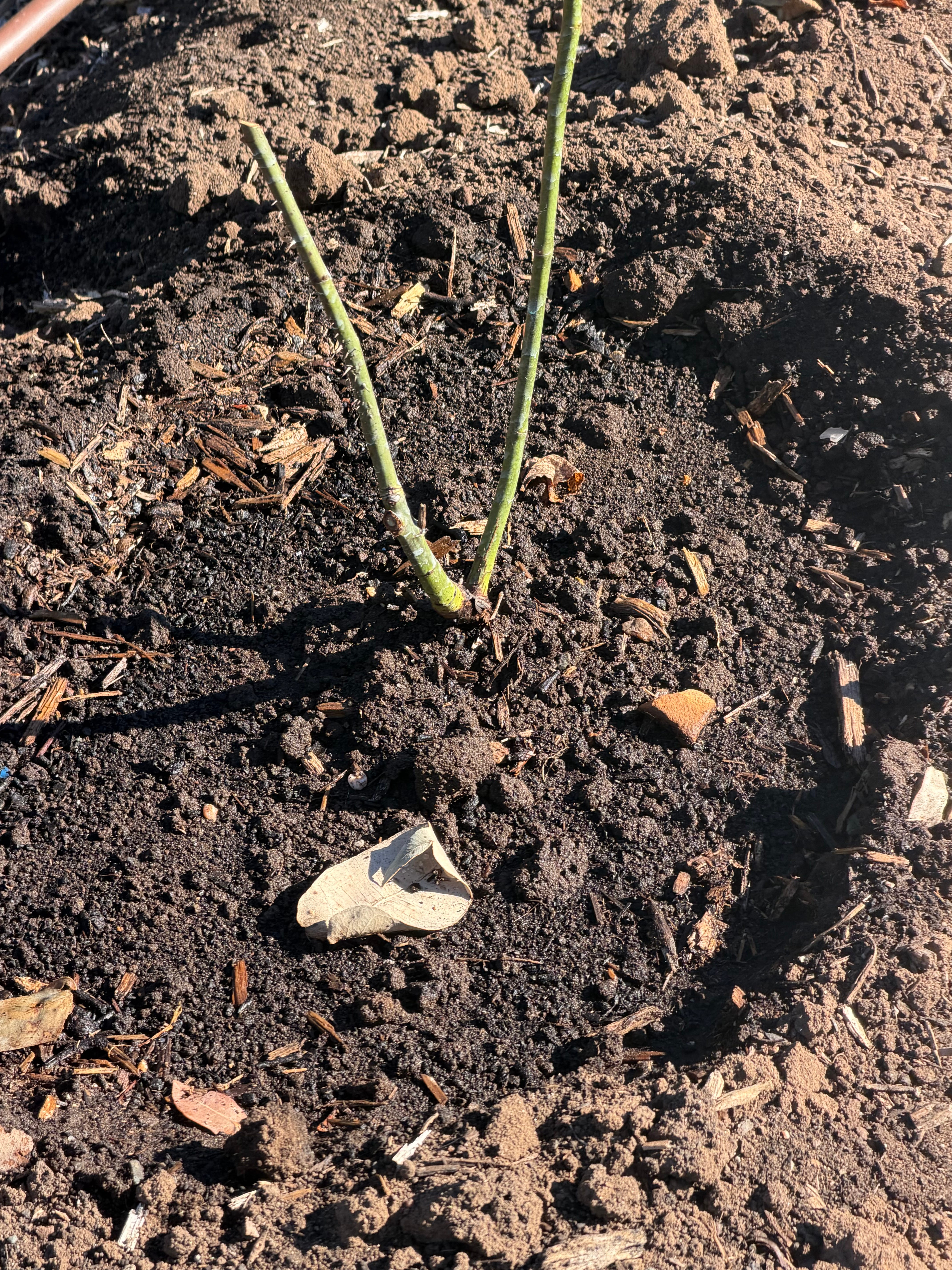
In order to fill that corner where I planted those two original slips, I’ve long been studiously ‘pinning down’ long stems in that space, in an attempt to force more flowers during the brief spring season this rose puts on its show. Consequently, many of those pinnings have formed roots and so…once the idea lodged, I just couldn’t get to the task fast enough! I almost ran to the potting shed to find the digging fork, and went about digging then snipping from the parent roots, one, two…then three, four, five separate plants - each with their own individual, healthy root system in tact!
Then; carefully choosing to not plant exactly where the roots of the previous roses had been, I made each hole with a little interior mound, laid the roots of these new roses gently over, then backfilled and made a ‘dish’ around the base of each new stem, to capture water (in the spirit of last week’s post’s explanation of the ancient rill irrigation systems implemented by the Moors in Spain - the water has nowhere to go but directly to the roots).
And so…I now have five new specimens of that Lebanese rose. How I would love to know its actual name! We’ll get there…one step at a time. Although I’m not hopeful these new slips will put on enough growth this year, to provide enough roses for the distillation of my intent, I am hopeful they will grow into sturdy specimens in this more open position with a full-sun aspect. Will I ever get to carry out that distillation and connect all the peeps involved in this story as I would like? I have absolutely no idea…but it is something I would oh so love to do. I don’t know if Nadia’s neighbourhood friend is still alive…but if she is, and I can bring the entire story to a full-circle and happy conclusion, it would be such a lovely thing for us all to celebrate.

I know I mentioned this book at some point recently…published just this year, Sivine is one of the nine Arab-Australian women who have each contributed their story of beginning a new life in this country, while carrying a deep connection to the one of their birth and the generations before them. It makes for emotional reading and I cannot recommend more highly that you find your way to its pages… (where yes…Sivine does indeed touch on the story of the roses).
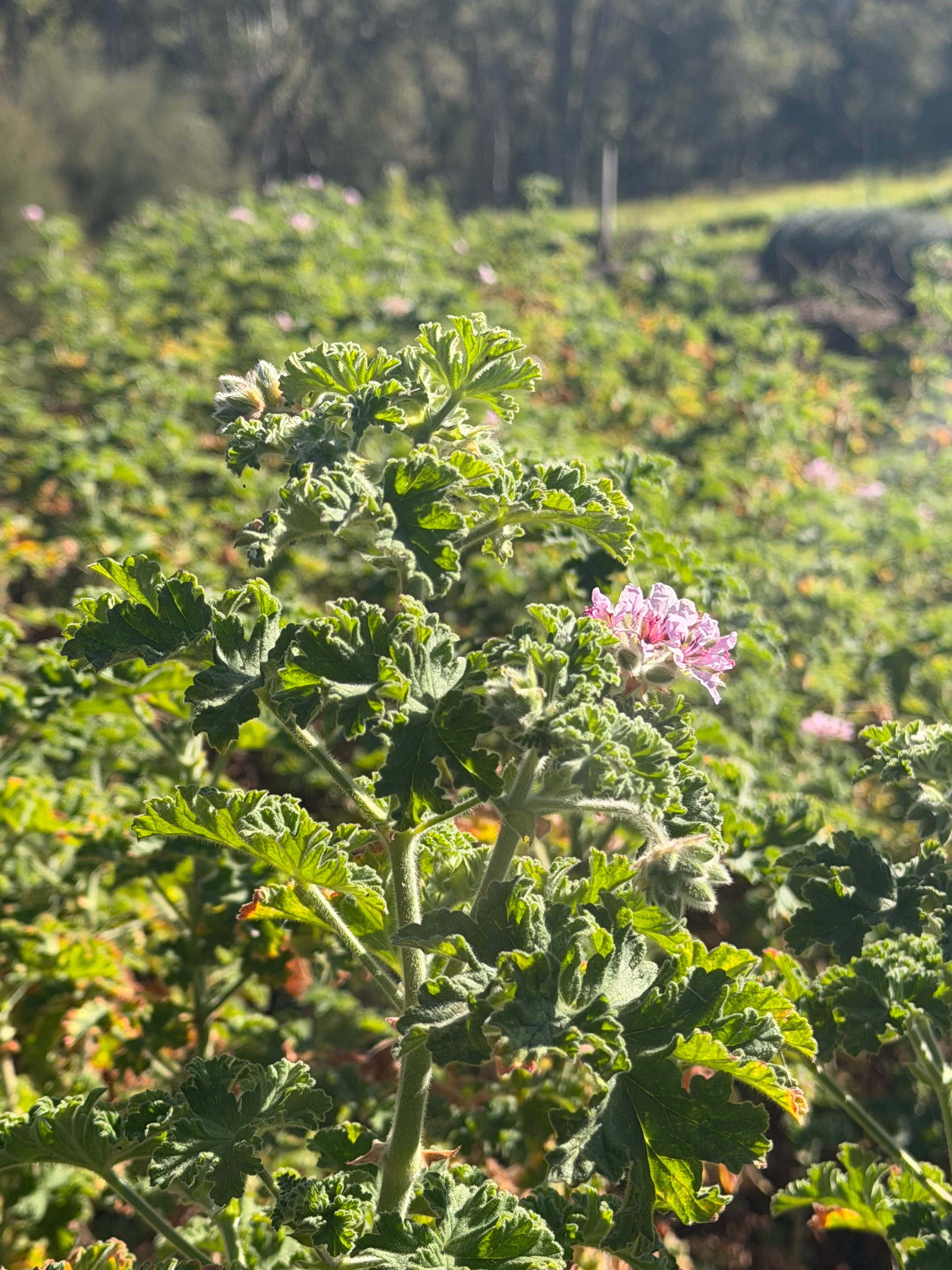
While we’re down in the Field…or were before I got carried away…(and as I was this morning to water those five roses), just look at the row of Rose Pelargonium! It was all I could do to leave this vision behind this morning and come to my desk instead of getting Hildegard out of hibernation! The need to distil the bounty from this row is building rapidly now…I can feel the tingle from my fingertips to my toes. All of a sudden I need to make a plan around the task - as a rule it isn’t something I do at the weekend…Monday? Tuesday? A spontaneous workshop? All I know is I need to do something quite quickly! Maybe I’ll give Hildegard a citric acid bath tomorrow - it’s time for her annual one and as this is the start of the season…
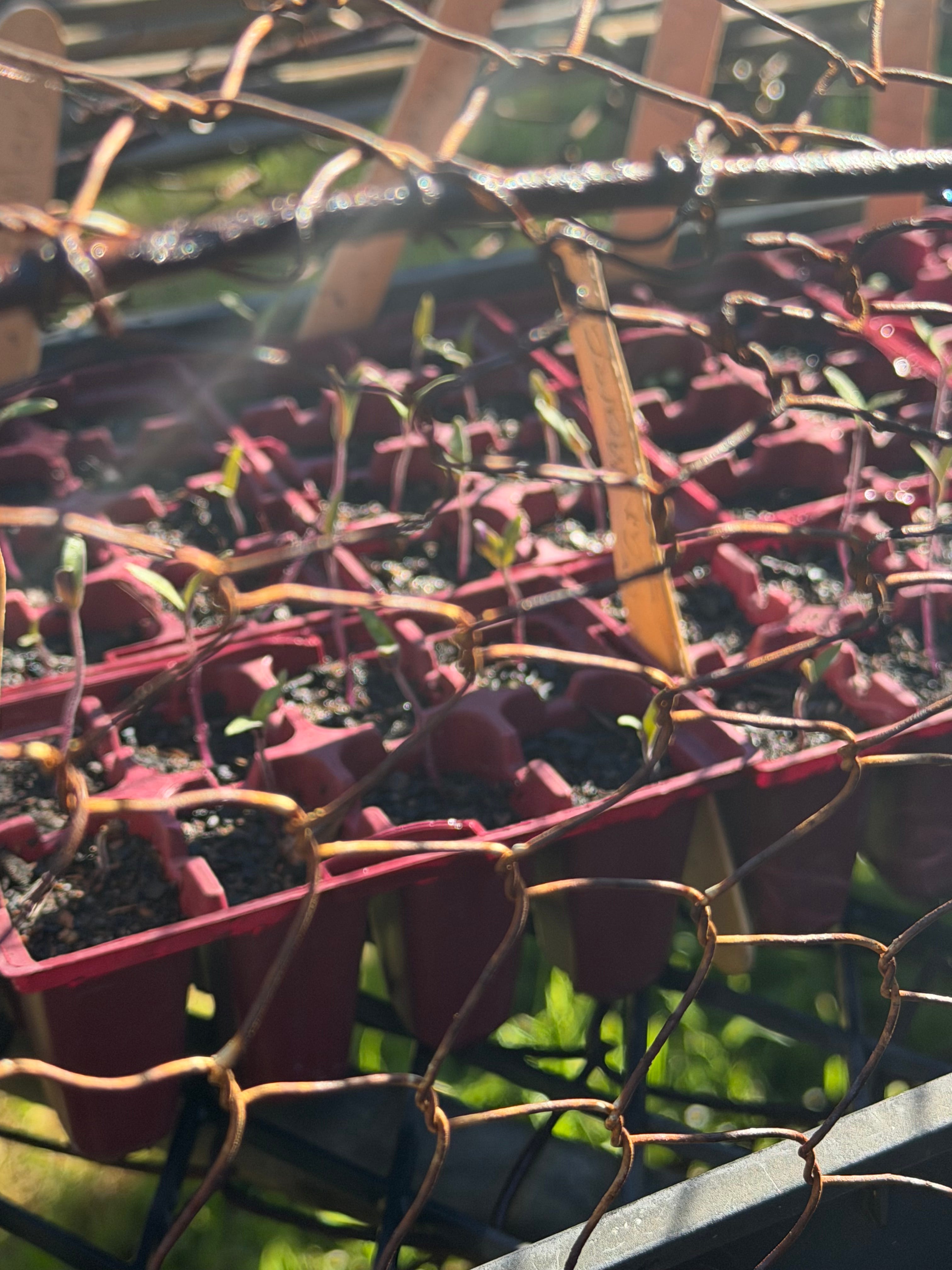
Before I forget…almost all the tomato seeds have germinated.I don’t want to jinx them, but I’m thrilled with their progress and tho it’s not too late if you want to grow tomatoes from seed this year, do be quick to get seed into punnets now. I’ll grow these on til fine roots begin to appear at the bottom of each punnet cell, then all being well and no calamities between now and then…I’ll pot them on into long thin root-trainers, so they’re good and sturdy seedlings before they go out into the garden in late spring.
In other news…really my week has been a funny mix. With Bonnie and a friend down for a few days from the north, instead of being at my desk on Monday and Tuesday, I found myself (dealing with the pumpkin saga aside!) playing tennis - it would seem I can still hit a ball; and even table tennis - can seemingly still send shots whizzing over that net too (it’s been a long time!) though I never have recommended trying to wrangle bat or racket one so soon after the other - they’re a quite discombobulating combination! Interspersed with the careful piecing together of a very special upcoming event that requires serious thought and care…I’m looking forward to a gardening weekend!
Enjoy these sparkling winter days and I’ll look forward to catching you again next week.
Warmest wishes
Mickey x
Eating from the garden: Pumpkin, broccoli, celeriac, kale, fennel bulbs, peas, kohl rabi, leek, bok choy, tomato (just one vine left now!), warrigal greens, coloured chard, chicory, lettuce, red elk, celery, Jerusalem artichoke. Rhubarb, orange, lemon. Coriander, lovage, mint, chives, parsley, rosemary, sage, thyme, oregano. Nasturtium, calendula and borage flowers, fennel fronds
Going / gone: tomatoes, lovage, pumpkin
Seed saving: none
Sowing: not too late to sow tomato seed but be quick now if you’re going to do it…and for capsicums and aubergines too - into punnets, for planting out in the spring.
Planting: lettuce seedlings…I’m still dropping the odd one in here and there, as we eat our way through those already established
Ornamental garden notes:
Picking for the house: a single rose here, a single rose there…if they want to flower, I’m not going to stop them! Dentata (or French) lavender and jasmine and the apple scented pelargoniums have sent out stems of tiny white flowers…
Perfumes and aromas: jasmine! Ooooh how I love it. Still the osmanthus fragrans and lonicera fragrantassima are spilling their scent and I have a feeling the Daphne is about to…while the apple scented pelargonium is…and as for the rose pelargonium…
Pruning and other: I finished pruning all the roses and I think pretty much everything else has had its winter prune now, except for the fruit trees in the orchard and odd other specimens. With Thalia I took to the espaliered trees in the kitchen garden last week, because two sets of eyes are better than one - and I’m inclined to take out more growth than her, so a second pass has lightened their load. She sprayed them yesterday with copper oxychloride to prevent fungal disease (it’s ok if you’re growing organically) and I’m so glad we’re up to this point ahead of time, because I feel that bud-burst is just around the corner. Thalia weeded both the labyrinth and the willow circle this week…it’s time again to weed the lawn gutters; and with help from our plumber’s son, Larry cleared the roof gutters of the house and the dairy…all in anticipation of the coming spring.
Hi Mickey,
Your pumpkin rot issue could be related to mineral deficiency during the growing period. If the plant has adequate Zinc, Manganese, Iron, Magnesium, Boron, Calcium, Silicon, Copper, Manganese, Sulfur, Potassium the stem and fruit will be resistant to the pathogens that likely caused the rot.
Best way to know is by sap testing the leaves as the plants grow and applying the minerals that are deficient, at the right times.
In Sydney it was a fairly wet season during pumpkin harvest time so that probably didn't help.
Hope you're well, Steve :-)